-
 Alpinamed AG
 To news overview
What is creatine and how does it work in the body?
Creatine is a compound naturally produced by the body and plays an important role in the rapid supply of energy to the muscles. Most of the creatine in the body is stored in skeletal muscle. Some of it is present in the form of what is known as phosphocreatine. Creatine is neither a protein nor an anabolic steroid. Our body can produce creatine itself. In addition, we obtain smaller amounts through our diet, particularly from meat and fish.
Creatine supports the rapid supply of energy
To understand how creatine works, it is helpful to take a closer look at ATP. ATP stands for adenosine triphosphate and is the immediately available energy source for our cells. When a muscle requires energy, ATP is converted into ADP, releasing energy in the process. During short, intense periods of exercise, ATP needs to be replenished particularly quickly. This is where phosphocreatine comes into play: it provides a phosphate group, allowing ATP to be regenerated from ADP. This rapid energy system is particularly important during activities that last only a few seconds or are performed repeatedly at high intensity. Examples include strength training and sprinting.
Regular intake is key
Creatine does not work like a short-term stimulant. Therefore, no immediate boost in energy should be expected after taking it. With regular intake, creatine and phosphocreatine stores in the muscles can be increased. Consistent daily intake is therefore more important than the exact timing before or after exercise.
Creatine increases physical performance during high-speed strength training as part of short-term, high-intensity physical activity. The beneficial effect is obtained with a daily intake of 3 g of creatine.
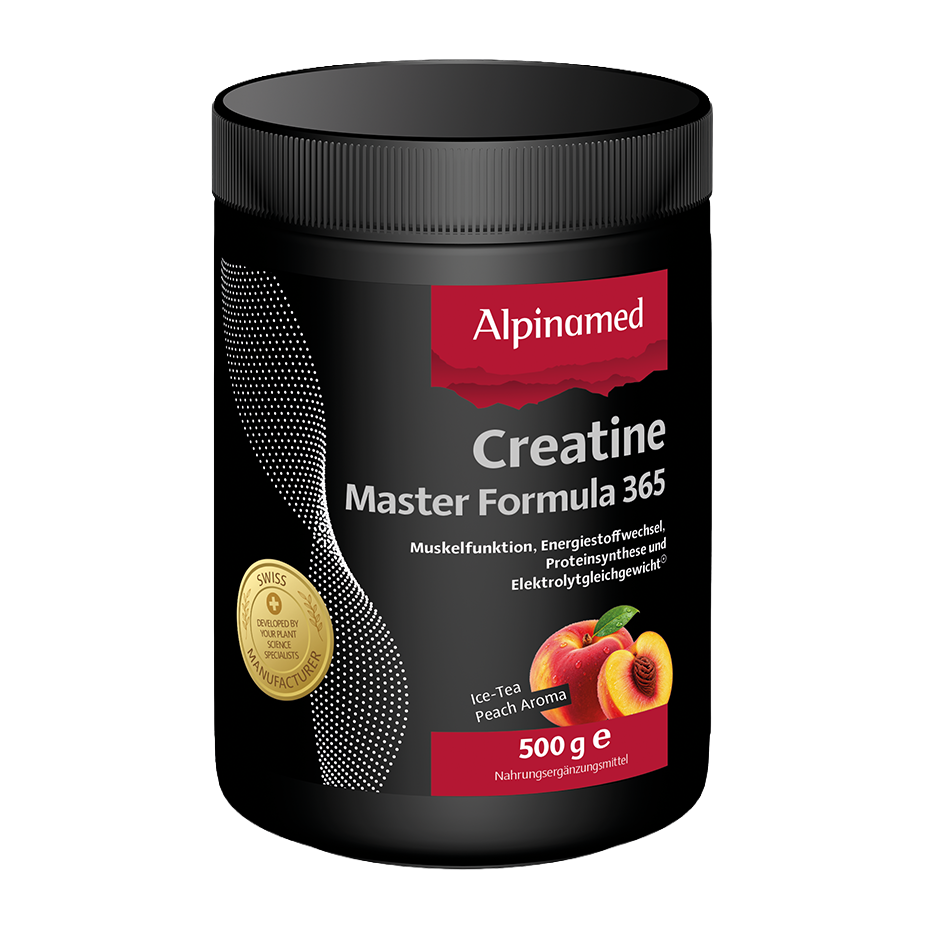
The dosage of Alpinamed Creatine Master Formulaforte Sticks is designed accordingly: one stick contains, among other ingredients, exactly 3 g of creatine and corresponds to the intended daily serving. Creatine is not a substitute for strength training or a balanced diet. Training provides the necessary physical stimulus, while a balanced diet supplies the body with important nutrients. Creatine complements this interaction by supporting the rapid energy system of muscle cells.
How the creatine–ATP system works in simple terms
Intense exercise
↓
ATP is used
↓
ATP is converted into ADP
↓
Phosphocreatine provides a phosphate group
↓
ATP can be regenerated from ADP
↓
ATP is once again available as a short-term energy source
This mechanism explains why creatine is primarily studied in connection with short, intense periods of exercise and should not be regarded as general support for every form of physical activity.
Practical for everyday use
Taking creatine can easily be integrated into everyday life. Whether at breakfast, after training or at another time of day is less important than regularly taking the recommended daily portion. The easiest way is to establish a fixed routine that fits well into your personal daily schedule.